Why Does Cilantro Taste Like Soap to Some People? The Genetics Behind the Most Divisive Herb
Cilantro tastes like soap to some people because of OR6A2, an olfactory gene that heightens aldehyde detection. Genetics, explained.
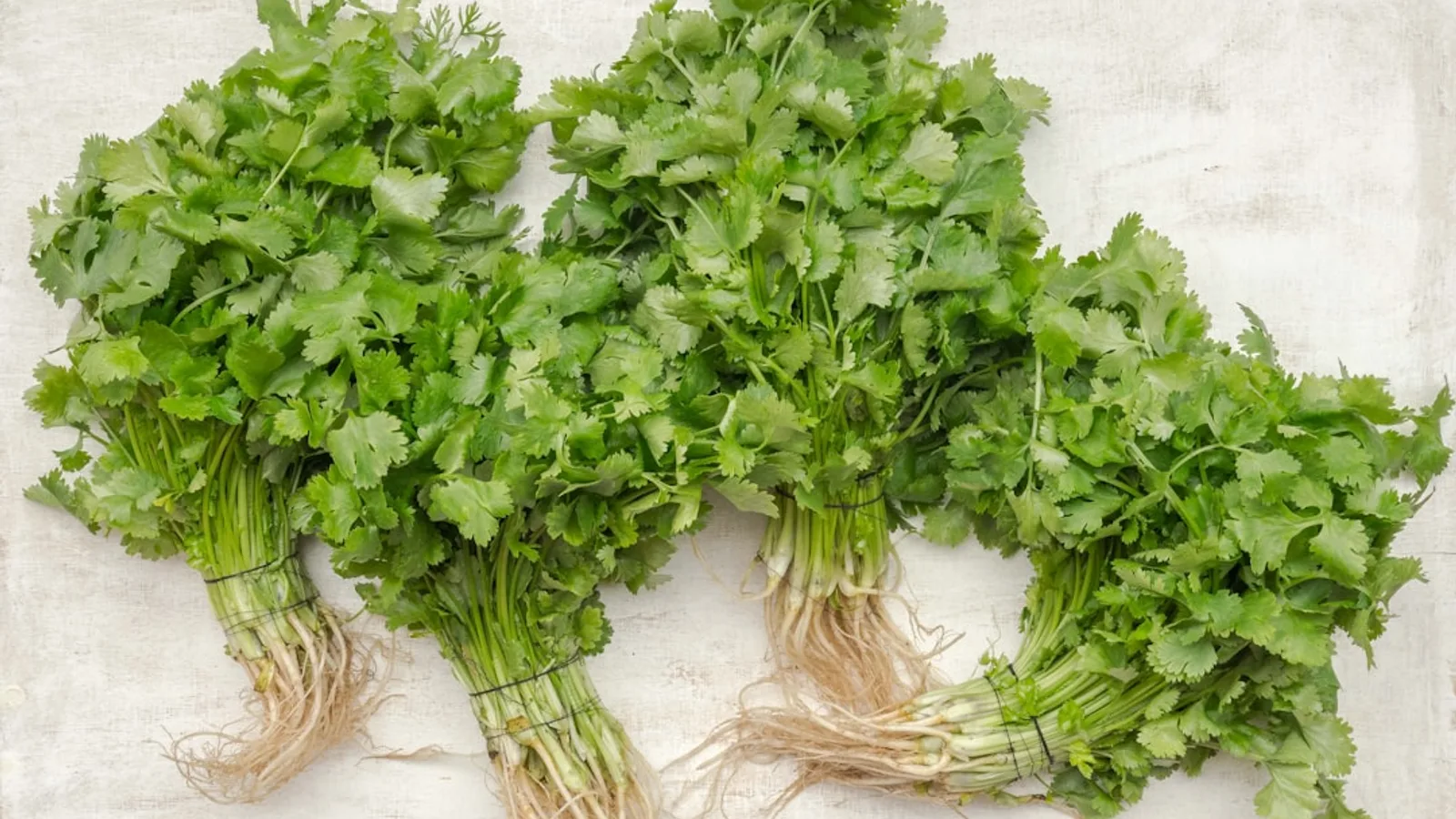
Cilantro is probably the most divisive herb in any kitchen. People who love it tend to describe it as fresh, citrusy, and clean. People who don’t tend to use words like soapy, chemical, or, as John Gerard wrote in his 1597 herbal, “venemous.” That gap between those two experiences is not really a matter of taste in the personal-preference sense. It’s a matter of genetics, and specifically a matter of which version of an olfactory receptor gene you happen to be carrying.
The compounds first
Before getting to the gene, it helps to understand what’s actually in cilantro that divides people so cleanly. The herb’s characteristic aroma comes primarily from a group of chemical compounds called aldehydes, specifically unsaturated aldehydes like (E)-2-decenal and (E)-2-dodecenal, along with a class called n-aldehydes including decanal and dodecanal [1]. These compounds are described by the researchers who study them as soapy, fatty, or pungent, and if that sounds familiar, it’s because the same classes of aldehydes are in fact found in soap and a range of processed products.
To most people, these aldehyde compounds register in combination with cilantro’s other aroma chemicals as something herbaceous and bright. But to a meaningful subset of the population, the aldehyde signal is strong enough to dominate the entire experience, overwhelming whatever else the herb has going on and producing something that registers as unmistakably soapy. The question is why some noses respond to those aldehydes so differently.
A genome-wide association study, 14,000 people, one region
In 2012, researchers at 23andMe conducted a genome-wide association study (GWAS) of cilantro soapy-taste detection using data from 14,604 unrelated participants of European ancestry who answered whether cilantro tasted like soap to them [1]. They found one SNP (a single-nucleotide polymorphism, a specific site in the genome where individuals differ by one DNA letter) that was significantly and reproducibly associated with detecting a soapy taste [1]. That SNP, rs72921001, lies on chromosome 11 within a cluster of eight olfactory receptor genes [1].
The most compelling gene in that chromosomal cluster is OR6A2. It encodes an olfactory receptor with documented high binding specificity for the very aldehydes that make cilantro smell the way it does, including (E)-2-decenal, which is one of the key cilantro aroma compounds [1,3]. A wide range of odorants have been found to activate OR6A2, and all of them are aldehydes [3]. This makes it a very plausible candidate for the receptor that, in some people, is registering those cilantro compounds loudly enough to produce the soapy perception.
What makes this finding especially clean is that the index SNP is also in high linkage disequilibrium with non-synonymous variants in a neighboring gene, OR10A2, which may also be contributing [1]. But OR6A2 remains the leading candidate for the specific biological mechanism here.
This is a perceptual difference, not a preference difference
Here’s the part that tends to get lost in how cilantro-soap detection gets discussed: people who find cilantro soapy aren’t responding badly to the same flavor everyone else experiences. They’re detecting a genuinely different signal. Their olfactory hardware (a receptor that binds aldehyde molecules) is wired to register those specific compounds more intensely, or differently, or both. The result isn’t “they don’t like what we like.” It’s closer to “they’re smelling a partially different thing.”
This is a distinction worth making clearly, because it comes up across a lot of genetic taste and smell research. Genetic variants in olfactory receptor genes change the molecular receptive range of the receptor: the chemical signatures it responds to and how strongly [3]. That’s a hardware-level difference, not a software preference that develops through experience. It reframes “picky eater” as a categorically inaccurate description.
How common is it, and does it vary by ancestry?
About 13% of European participants in the GWAS study reported that cilantro tasted soapy [1]. But the rate varies noticeably across ancestries. In the same dataset, South Asians showed the lowest rate (around 3.9%), while East Asians and Latinos reported rates of roughly 8-9% [1]. Europeans clustered around 12-13%. Women were also significantly more likely than men to detect a soapy taste across the board, with an odds ratio of 1.36 [1].
The ancestral differences don’t appear to be fully explained by the frequency of the rs72921001 variant across populations, which suggests either that other genetic factors are at play, or that environmental factors like lifetime exposure to cilantro modulate the experience significantly [1]. Interestingly, South Asian cuisines historically use cilantro very prominently, and the much lower rate of soapy detection in South Asian participants is consistent with the idea that either genetic selection or long-term exposure (or both) play a role.
So is it permanent?
Mostly, but not entirely. The genetic component is real and fairly well-established. A twin study estimated the heritability of cilantro dislike at 0.38 for odor and 0.52 for flavor, meaning genetic factors account for a meaningful share of the variance [2]. But heritability isn’t destiny, and the GWAS authors themselves point out that the SNP they identified explains only about 0.5% of the variance in soapy-taste detection [1]. The total heritability tagged by common SNPs was estimated at just 0.087, low enough that there’s clearly a lot going on that genetics alone doesn’t explain [1].
One likely explanation is that repeated exposure does shift things somewhat. The brain’s interpretation of a smell signal isn’t fixed; it can be reweighted over time as learned associations build up around an odor. Someone who grows up eating cilantro constantly may habituate to the aldehyde signal in a way that someone encountering it rarely doesn’t. This would explain why many cilantro-soapers report that their aversion has softened somewhat with repeated exposure, even if it never entirely disappears.
But that softening is a cognitive adaptation built on top of a fixed receptor: the brain adjusting how it interprets a signal that the olfactory receptor itself is still generating in the same way. The underlying hardware hasn’t changed.
The broader point about genetics and flavor
Cilantro is a low-stakes but genuinely illuminating example of something that applies broadly in the genetics of taste and smell: what we experience as flavor is not a straightforward response to objective chemical properties. It’s the output of sensory receptors that vary between individuals, filtered through neural processing that’s also shaped by genetics and experience. Two people eating identical food are having non-identical sensory experiences, and sometimes those differences are substantial.
So the next time someone at a dinner table insists that their cilantro tastes like soap, the correct response is probably to take that seriously as a sensory report. At the receptor level, they’re not entirely wrong.
Common Questions
What percentage of people think cilantro tastes like soap?
Around 13% of people of European ancestry in one large study reported that cilantro tastes soapy, though the proportion varies significantly by ancestry. South Asians reported the lowest rates at around 4%, while figures up to 21% have been reported in other populations.
Which gene is responsible for cilantro tasting like soap?
The leading candidate is OR6A2, an olfactory receptor gene on chromosome 11 that has high binding specificity for the aldehydes responsible for cilantro's characteristic smell. A genetic variant near this gene was significantly associated with detecting a soapy taste in cilantro in a GWAS of over 14,000 people.
Can you train yourself to like cilantro?
Possibly to a degree. Some people report that repeated exposure shifts their perception over time, and the soapy taste detection appears to be influenced by environmental factors as well as genetics. But because the aversion is rooted in how an olfactory receptor is wired, the shift tends to be modest rather than a complete reversal.
Is cilantro aversion more common in women?
Yes, at least in the data available. In one large study, women were significantly more likely than men to detect a soapy taste to cilantro, with an odds ratio of 1.36.
References
- [1]Eriksson N, et al. A genetic variant near olfactory receptor genes influences cilantro preference. Flavour. 2012
- [2]Knaapila A, et al. Genetic analysis of chemosensory traits in human twins. Chem Senses. 2012
- [3]Araneda RC, et al. The molecular receptive range of an odorant receptor. Nat Neurosci. 2000