Why Does Your Eye Twitch?
That fluttering lower eyelid isn't random. Screen time, caffeine, and even a migraine medication can trigger it. Here's the actual biology behind it.
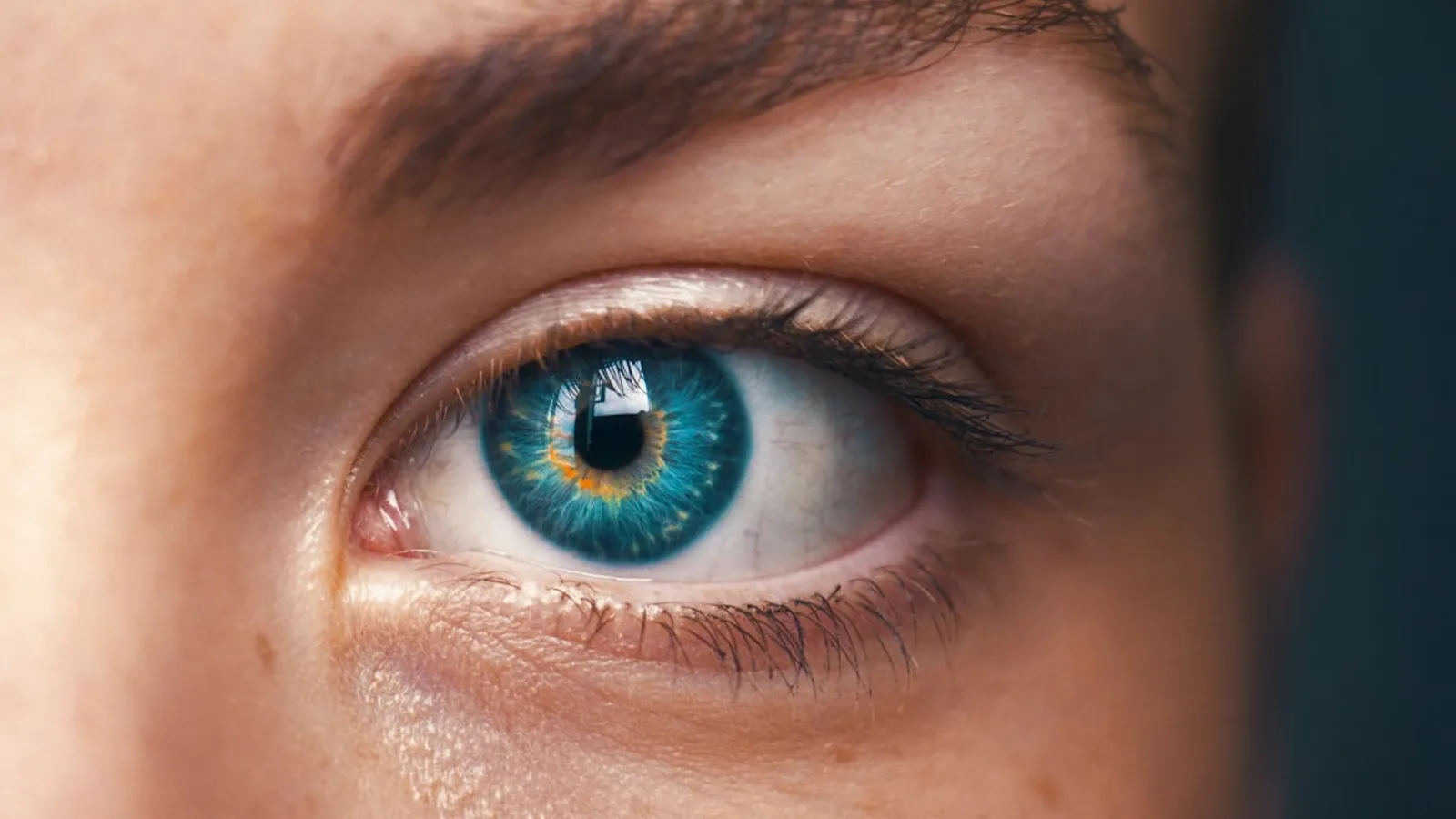
At some point almost everyone feels it: a small, rhythmic flutter in the lower eyelid that seems to come from nowhere and refuses to stop for an afternoon, a day, sometimes longer. It’s not painful, it’s barely visible to anyone else, and yet it’s strangely hard to ignore. The medical term is eyelid myokymia, and despite how alarming it can feel in the moment, it’s one of the most well studied and reliably benign phenomena in neuro-ophthalmology. Here’s what’s actually happening under the skin, what triggers it, and when (rarely) it’s worth paying attention to.
What’s actually twitching
The muscle responsible is the orbicularis oculi, a thin ring of striated muscle that surrounds each eye and is the only muscle capable of closing the eyelid [5]. It has two main working sections: an orbital portion that handles forceful, voluntary closure, and a palpebral portion right around the lid margins that fires during regular blinking [5]. Eyelid myokymia almost always involves the palpebral portion of the lower lid, and it’s typically unilateral, affecting one eye and not the other [1].
Myokymia itself is a specific kind of muscle activity. Under electromyography, it shows up as involuntary, fine, undulating contractions produced by spontaneous, repetitive firing of one or a few motor units, usually at a rate of about 3 to 8 Hz, followed by a brief silent interval before the next burst [3]. This is different from a normal muscle contraction, which is a coordinated event across many motor units triggered by a voluntary signal. With myokymia, individual motor units are essentially misfiring on their own, producing that visible ripple under the skin without you doing anything to cause it.
The orbicularis oculi is innervated by the facial nerve (cranial nerve VII), which originates in the pons and travels a long path through the skull before reaching the muscle [5]. That anatomical detail matters, because it’s the reason facial myokymia involving the lower face is taken far more seriously than eyelid myokymia. Myokymia affecting the cheek or jaw is often a sign of a lesion somewhere along the facial nerve’s course through the brainstem, frequently linked to multiple sclerosis or, less commonly, a brainstem tumor [1,6]. Isolated eyelid twitching, by contrast, is thought to arise from a peripheral rather than central mechanism, and it behaves completely differently in the clinic.
Why it happens
The honest answer is that the precise trigger mechanism isn’t fully worked out. What is well established is the list of associated factors, and it reads like a summary of a rough week: stress, fatigue, physical exertion, and excessive caffeine intake are the most consistently cited [1,4]. A retrospective review of 15 patients with chronic isolated eyelid myokymia found that more than half reported smoking, moderate alcohol intake, or moderate caffeine consumption, though the researchers couldn’t establish a clear temporal link between any single habit and the onset of symptoms [1]. Two of their patients did see their myokymia improve within six months of resolving significant work-related stress, which at least suggests the connection isn’t purely coincidental [1].
The screen time connection
A more recent and genuinely useful piece of the puzzle comes from a 2024 case-control study out of Turkey, which is the first to formally investigate a link between digital screen time and eyelid myokymia [2]. The researchers compared 103 patients with eyelid twitching lasting more than two weeks against 103 healthy controls matched for age, sleep duration, working hours, and coffee intake, specifically to rule out those other variables as confounders [2].
The results were fairly striking. The myokymia group averaged 6.88 hours of daily screen time compared to 4.84 hours in the control group, a statistically significant difference, and there was a strong positive correlation between how much time someone spent on screens and how long their twitching had been going on (r=0.670) [2]. Refractive error, intraocular pressure, and blood electrolyte levels (calcium, sodium, potassium, magnesium) showed no meaningful difference between the two groups, which ruled out several of the more commonly assumed culprits [2].
The proposed mechanism is about blink dynamics rather than light exposure per se. Sustained focus on a screen reduces blink rate, and regular rhythmic blinking is what allows the orbicularis oculi to fully relax after each contraction [2]. The theory is that prolonged, incomplete relaxation of the muscle during long screen sessions creates the conditions for that spontaneous motor unit misfiring to take hold. It’s a reasonable hypothesis, though the study itself acknowledges its limitations: a single-center design, a modest sample size, and self-reported screen time [2].
When it’s the medication, not the lifestyle
Sometimes the trigger is more specific than “a stressful week.” A 2015 study followed 140 migraine patients being treated with topiramate and found that eight of them (5.7%) developed eyelid myokymia after starting the drug [3]. The pattern was consistent: symptoms appeared within the first month of treatment, topiramate was stopped and the myokymia disappeared in every case, and when the drug was reintroduced, the twitching came back with the same characteristics in all eight patients [3]. Brain imaging and blood work (potassium, calcium, thyroid function) were normal across the board [3].
Topiramate affects several ion channel systems at once, including voltage-dependent sodium channels, calcium channels, and potassium conductance, and the researchers suspect the myokymia relates to its effects on the calcium and potassium channels that govern nerve fiber excitability, though the exact pathway remains unclear [3]. Interestingly, this pattern of drug-induced myokymia isn’t unique to topiramate; it’s also been reported with flunarizine and clozapine, drugs that act on different but related channel systems [3]. If your eye twitching started right around the same time as a new prescription, that timing is worth mentioning to whoever prescribed it.
The rare case when it’s something more
Isolated eyelid myokymia essentially never turns out to be the first sign of neurologic disease, and the imaging studies that get ordered for reassurance are, statistically, almost always unnecessary [1]. But “almost never” isn’t “never.” One case report described a 34-year-old woman whose eyelid myokymia became continuous and, after ruling out the usual triggers, led to an MRI that revealed white matter lesions consistent with multiple sclerosis [6]. What distinguished her presentation from a typical case wasn’t the eyelid twitching alone but the accompanying findings on neurological exam, along with the fact that it never resolved on its own [6].
The key distinction clinicians look for is whether the myokymia spreads. Facial myokymia that progresses beyond the eyelid to involve the rest of one side of the face is a different, more concerning entity, usually linked to a lesion along the facial nerve’s path through the brainstem [1,6]. That kind of spread is rare, and even continuous facial myokymia associated with MS tends to self-limit within a few weeks to six months rather than persisting indefinitely [6]. Isolated eyelid involvement that stays isolated, even if it’s been going on for months, is the pattern that’s repeatedly shown to be benign across multiple studies [1,4].
Does tonic water actually help?
This one comes up constantly, and it’s worth addressing directly because the underlying logic sounds reasonable at first. Tonic water contains quinine, which does have a genuine mechanism for reducing nocturnal leg cramps, working through non-competitive inhibition of acetylcholine receptors at the neuromuscular junction [4]. The problem is that eyelid myokymia and a nocturnal leg cramp are not the same kind of muscle event, and there’s no clinical trial data showing quinine does anything for myokymia specifically [4].
There’s also a real safety consideration here that gets glossed over online. The FDA has warned against off-label quinine use for muscle cramps because of the risk of cinchonism (hearing loss, tinnitus, tremor, ataxia) at higher doses, along with rarer but more serious complications like thrombocytopenia and cardiac arrhythmias [4]. A one-liter bottle of tonic water contains at most about 83 mg of quinine under FDA labeling limits, which is a low dose, and a short trial of a glass or two probably isn’t going to hurt anyone [4]. But the improvement people report is very likely just the myokymia running its naturally self-limited course, not the quinine doing anything meaningful [4].
What actually helps
For most people, the practical approach lines up closely with what the research points to as triggers: cut back on caffeine, get more sleep, address the source of stress if there is an obvious one, and take real breaks from screens with deliberate, complete blinks [1,2,4]. None of this is complicated, and it reflects the fact that eyelid myokymia is, in the vast majority of cases, your muscle’s very literal response to a body that’s running on too little rest and too much stimulation.
If it becomes chronic and genuinely disruptive, botulinum toxin injected into the affected muscle is a well established and effective treatment, with most patients in long-term follow-up studies reporting real improvement [1]. It’s not a first step for a twitch that started this week, but it’s a legitimate option for something that’s persisted for months and isn’t going away with rest.
Summary
Eyelid myokymia is your orbicularis oculi muscle briefly misfiring at the motor unit level, most often set off by some combination of stress, fatigue, caffeine, and, based on the most recent evidence, too many uninterrupted hours in front of a screen. It’s overwhelmingly benign, it’s not related to your electrolyte levels or your eyeglasses prescription, and outside of very rare cases where it spreads beyond the eyelid or simply never stops, it doesn’t warrant imaging or specialist workup. The tonic water probably isn’t doing much either way. Rest, less caffeine, and more blinking are still the best evidence-backed advice for making it go away.
Common Questions
Is eyelid twitching a sign of something serious?
Almost never. The large majority of cases are isolated to the eyelid, resolve on their own within days to weeks, and are not associated with any underlying neurologic disease. It only becomes worth investigating if it spreads to other muscles of the face or persists continuously for months.
Why does caffeine make my eye twitch worse?
Caffeine is one of the most consistently reported triggers alongside stress, fatigue, and alcohol, though the exact mechanism in eyelid muscle specifically hasn't been pinned down. Cutting back is a reasonable first step if you're dealing with a flare-up.
Does tonic water actually stop eyelid twitching?
There's no clinical trial evidence that it does. The quinine in tonic water has a plausible mechanism for muscle cramps, but eyelid myokymia is a different kind of muscle activity, and any improvement people report is probably just the twitch running its natural course.
When should I actually see a doctor about it?
If the twitching spreads beyond the eyelid to other parts of the face, becomes continuous for months rather than intermittent, or is accompanied by other neurological symptoms. Isolated, intermittent eyelid twitching in an otherwise healthy person almost never needs imaging or specialist referral.
References
- [1]Banik R, Miller NR. Chronic myokymia limited to the eyelid is a benign condition. J Neuroophthalmol. 2004
- [2]Gunes IB. Association between eyelid twitching and digital screen time, uncorrected refractive error, intraocular pressure, and blood electrolyte imbalances. Cureus. 2024
- [3]Medrano-Martínez V, et al. Eyelid myokymia in patients with migraine taking topiramate. Acta Neurol Scand. 2015
- [4]Moshirfar M, et al. Will tonic water stop my eyelid twitching? Clin Ophthalmol. 2020
- [5]Rucker JC. Normal and abnormal lid function. Handbook of Clinical Neurology, Vol. 102. 2011
- [6]Palasí A, et al. Unilateral eyelid myokymia as a form of presentation of multiple sclerosis. Neurología. 2013