Why Do Humans Love Sugar So Much?
Sweetness triggers dedicated receptors, dopamine circuits, and an ancient survival pathway. Here's the biology behind why sugar is so hard to resist.
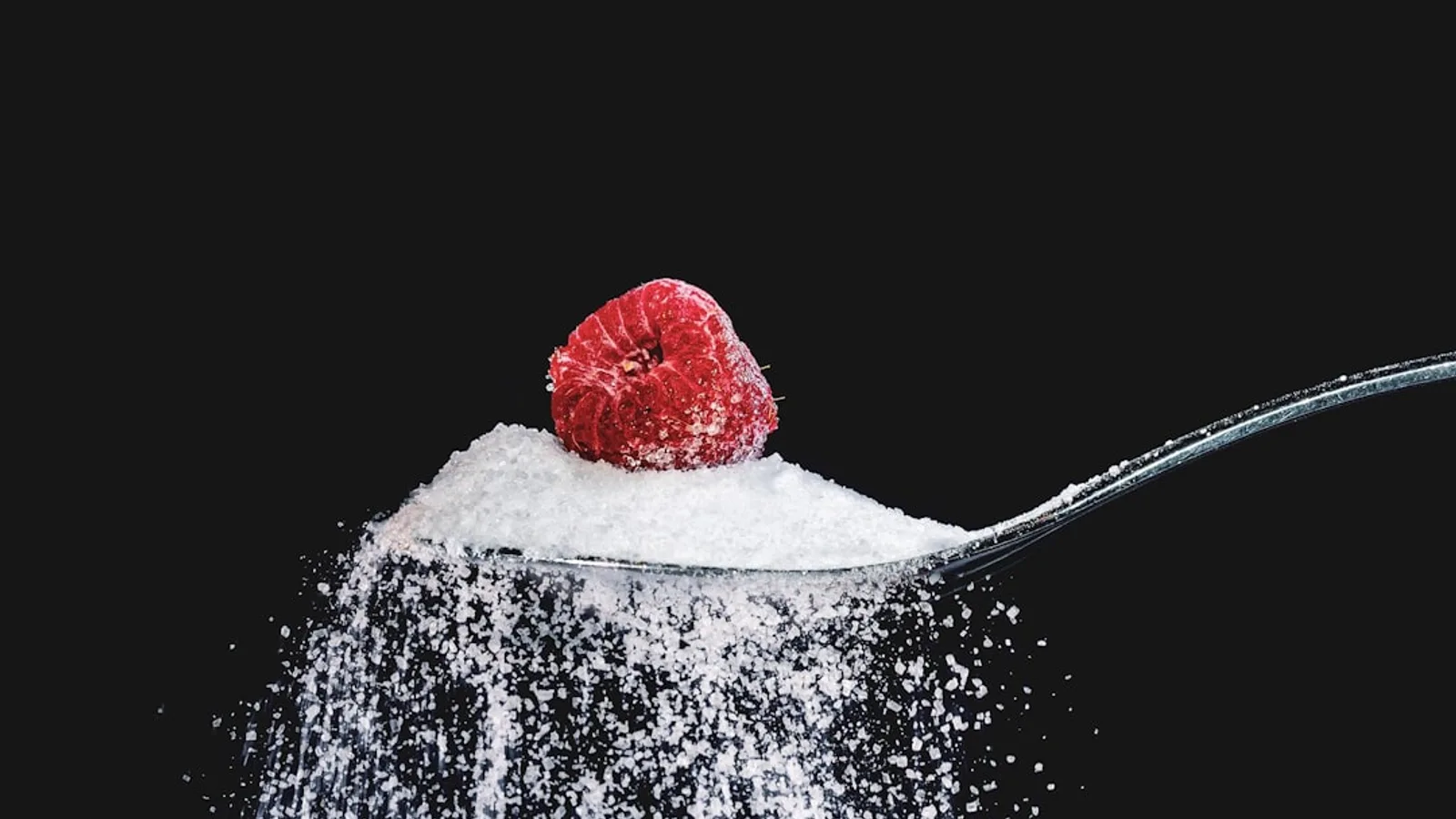
Walk down any grocery aisle and count how many products list sugar in the first five ingredients. It is not a coincidence or a conspiracy. Humans are built, at a receptor level and a circuit level, to find sugar close to irresistible. That pull did not come from marketing departments. It came from millions of years of biology rewarding anything that reliably delivered calories, and it runs so deep that even people who intellectually know they should eat less sugar still find themselves reaching for it. Here is what is actually happening in the body when sugar hits the tongue, and why the craving that follows is so hard to argue with.
The receptor doing all the work
Sweetness starts with a single receptor built from two proteins, T1R2 and T1R3, encoded by the genes TAS1R2 and TAS1R3. These two proteins combine inside taste receptor cells to form the sweet receptor, and alleles of one of the genes predict how avidly some mammals drink sweet solutions [1]. This is not a passive lock and key situation. Recent cryo-electron microscopy work has mapped exactly how the receptor changes shape when a sweetener binds it, and the mechanism turns out to be unusual compared to other receptors in its family. The sweet receptor belongs to a broader class of receptors that also detect bitter, umami, salty, and sour signals, and elucidating exactly how it responds to natural sugars versus artificial sweeteners could inform the design of better next-generation sweeteners [2].
What is interesting is that the receptor does not simply clamp shut on contact with sugar the way most receptors in its family do. Instead, sweetener binding causes a loop in the T1R2 subunit to insert itself between the two halves of the receptor, prying them apart into what researchers call a “loose” conformation, a shift that runs opposite to how related receptors typically respond to their own triggers [2]. That loose state showed up in roughly a third to half of all the receptor particles studied, which suggests it plays a real functional role rather than being some odd side effect of the imaging process [2]. There is even a hint that sweeteners which hold the receptor in that loose state longer might produce a stronger perception of sweetness, though that idea still needs to be tested directly.
The same receptor system also explains why bitterness and sweetness are so tangled up with each other. Sweet and bitter perception share overlapping biology, and children who are genetically more sensitive to bitter compounds report finding very sweet solutions more pleasant, preferring sweet carbonated drinks over milk compared to their less bitter-sensitive peers [1]. That connection is not trivial. It means the same genetic machinery that makes broccoli taste harsh to some kids is also nudging them toward soda.
Why sweetness feels rewarding, not just detectable
Detecting a sweet taste and wanting more of it are two different processes handled by different parts of the brain. Once sugar hits a taste receptor, the signal gets routed into the brain’s reward circuitry, and the dopamine system does most of the heavy lifting. The key insight from recent circuit-tracing work is that the brain actually runs two separate evaluations of sugar at the same time: how good it tastes, and how much energy it delivers.
This split matters because it explains behavior that otherwise looks irrational. Mice engineered to lack the ability to taste sugar at all will still learn to prefer glucose over a non-caloric sweetener, based purely on the signal generated after swallowing rather than on the taste itself [4]. Even more strikingly, animals will keep licking a bitter, unpleasant-tasting solution if it is paired with a stomach infusion of real sugar, choosing the bitter but calorie-rich option over a sweeter but calorie-free one [4]. The gustatory system says no, but the metabolic system overrides it. This dual-pathway setup is conserved all the way down to fruit flies, where entirely separate populations of dopamine neurons independently encode sweetness and nutrient value, letting the animal prioritize energy seeking over taste quality when the two conflict [4]. In other words, the drive toward sugar is not really about flavor at all. Flavor is just the advertisement. The real prize the brain is chasing is the calories behind it.
An old survival trick that never got the memo
Zoom out further and sugar’s pull starts to look less like a design flaw and more like a very old, very effective survival strategy. Fructose in particular has a metabolic quirk that sets it apart from other sugars. When the enzyme fructokinase C metabolizes fructose, it does so so quickly that intracellular energy and phosphate levels drop noticeably, and that drop functions almost like an internal alarm that shifts the body toward storing fuel rather than burning it immediately [5]. That shift toward fat and glycogen storage was extremely useful for an animal that could not predict when the next meal was coming.
Fat storage driven by fructose metabolism also happens to generate water as a byproduct, since oxidizing a gram of fat yields a bit over a gram of water, while glycogen yields several times that amount per gram [5]. This is part of why animals preparing for hibernation, long migration, or life in the desert lean so heavily on sugar-driven fat accumulation. Migratory birds fatten up before flights, bears do the same before winter, and some of the leanest-looking desert mammals still carry unusually high fat reserves for exactly this reason.
Humans carry two specific genetic scars from this history. Roughly 65 million years ago, early primates picked up a mutation that disabled the ability to synthesize vitamin C. Since vitamin C normally helps block fructose’s ability to stimulate fat production, losing that function meant fructose could drive fat storage more efficiently going forward [5]. Millions of years later, during a cooling period in the Miocene that wiped out much of the fruit supply ape ancestors depended on, a second mutation disabled the uricase gene. The loss of uricase activity meant a stronger uric acid response to fructose, which in turn amplified how much fat and glucose the body produced from the same amount of fructose [5]. Both mutations likely helped our ancestors survive lean periods. Neither one was built with a convenience store open at midnight in mind.
Not everyone wants it the same amount
Despite how universal a sweet tooth seems, the actual desire for concentrated sweetness varies a lot between people, and that variation follows some consistent patterns. Researchers have long divided people into two broad response types. Type I responders like increasing sweetness up to a moderate point before their preference drops off, while Type II responders keep liking a solution more as it gets sweeter, without much of a ceiling [1]. Age plays a role too. Children generally prefer higher concentrations of sucrose than their mothers do, a pattern that shows up across different racial and ethnic groups, though the liking for very concentrated sweetness tends to fade during adolescence [1].
Genetics contributes as well, though it is not the whole story. A review of family and twin data found that the degree of liking for individual sweet foods appeared to be genetically influenced, though the broader pattern of whether someone eats more carbohydrate than fat overall was even more heritable [1]. Later studies have gone further, linking sugar intake to specific chromosomal regions, including one location close to a sweet receptor gene. None of this means preference is fixed at birth. Internal state matters too, since drops in blood glucose measurably increase how much people want sweet foods, and mood plays a role given that sweet taste appears to trigger the release of endogenous opioids [1].
Can sugar actually be addictive?
This is where the research gets more contested. The strongest evidence for something resembling sugar addiction comes from a specific rat model involving restricted, intermittent access to sugar solutions rather than free access. Under that protocol, animals show several behaviors that overlap with the clinical criteria for substance use disorder. They escalate their intake over time in a pattern consistent with tolerance, and injecting sugar-dependent rats with the opioid antagonist naloxone produces several classic signs of opiate withdrawal along with anxiety-like behavior on standard behavioral tests [3]. Neurochemically, the pattern looks similar to drug withdrawal too, since sugar-dependent rats show the same drop in accumbens dopamine paired with a rise in acetylcholine that shows up during morphine withdrawal [3].
Human evidence is murkier. Questionnaire-based tools like the Yale Food Addiction Scale have found that a meaningful share of people report addiction-like patterns around food, but the researchers behind that work are careful to note the limits of the comparison. Sugar’s pull is probably closer to something like caffeine or nicotine than to cocaine or heroin, and there is a subtlety to it in that most people who would meet the criteria are not aware of it, in part because sugar overconsumption is not widely treated as a social problem the way drug use is [3]. It is also difficult to fully separate a biological drive toward sugar from the effects of dieting and restrained eating, since restrictive eating patterns on their own tend to inflate scores on these addiction-style questionnaires. Sugar reliably activates reward circuitry in ways that overlap with addictive substances, but whether that overlap adds up to true addiction in humans is still an open question.
Putting it together
Sugar’s grip on human behavior is not one mechanism but several stacked on top of each other. A dedicated receptor evolved to detect it with unusual sensitivity. A dual dopamine system rewards both its taste and the calories it delivers, sometimes overriding taste altogether when calories are on offer. An ancient metabolic pathway treats fructose as a fuel-storage signal left over from a world where the next meal was never guaranteed. And individual genetics shifts how strongly any given person feels all of this. None of these systems knew that sugar would eventually show up in nearly every packaged food on the shelf. They were built for scarcity, and they still operate as if scarcity is the default. Understanding that does not make sugar less appealing, but it does explain why willpower alone is often not enough to outrun biology that took millions of years to build.
Common Questions
Why does sugar taste good to almost everyone?
Two receptor proteins on the tongue, T1R2 and T1R3, combine to form a single sweet receptor that detects sugars and triggers a pleasure response. Nearly every person carries a working version of this receptor, which is why sweetness is one of the most universally liked tastes.
Is a preference for sweet food genetic?
Partly. Studies in mice and humans have linked variants in the sweet receptor genes TAS1R2 and TAS1R3 to differences in how strongly sweetness is preferred, and twin and family studies show a heritable component to sugar intake, though environment and experience matter too.
Does the body respond to sugar differently than to artificial sweeteners?
Yes. Sweeteners activate the same taste receptor, but only real sugar delivers calories the gut and brain can detect afterward. Animal studies show a separate dopamine pathway responds to that post-ingestive calorie signal, which is one reason sugar tends to be more reinforcing than non-caloric sweeteners over time.
Can someone actually be addicted to sugar?
The evidence is strongest in animal models, where intermittent sugar access produces bingeing, tolerance, and withdrawal-like symptoms that overlap with several criteria for substance use disorder. Human research is less conclusive, and many researchers argue sugar's pull is better described as intensely reinforcing rather than a clinical addiction in the way drugs are.
References
- [1]Reed DR, McDaniel AH. The Human Sweet Tooth. BMC Oral Health. 2006;6(Suppl 1):S17.
- [2]Wang H, Chen X, Dai Y, et al. Structure and activation mechanism of human sweet taste receptor. Cell Res. 2025;35:775-778.
- [3]Wiss DA, Avena N, Rada P. Sugar Addiction: From Evolution to Revolution. Front Psychiatry. 2018;9:545.
- [4]de Araujo IE. Circuit Organization of Sugar Reinforcement. Physiol Behav. 2016;164(Pt B):473-477.
- [5]Johnson RJ, Stenvinkel P, Andrews P, et al. Fructose metabolism as a common evolutionary pathway of survival associated with climate change, food shortage and droughts. J Intern Med. 2020;287(3):252-262.