Why Does Fermented Food Taste Different?
Fermentation doesn't just preserve food, it rebuilds its flavor from scratch. Here's how microbes turn bland ingredients into kimchi, cheese, and soy sauce.
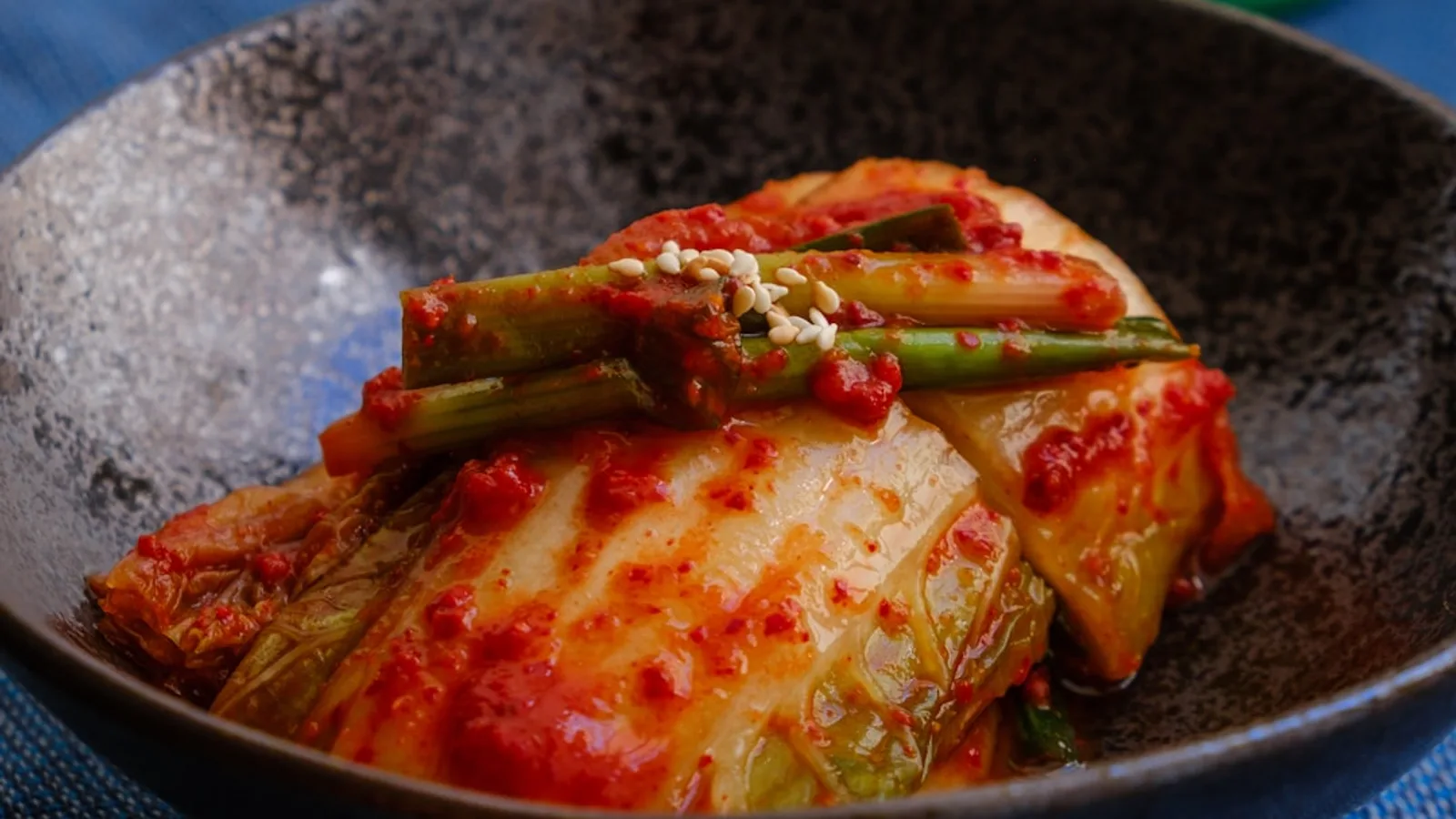
Bite into a fresh cabbage and then a spoonful of kimchi and you would be forgiven for thinking they came from different plants. Same goes for milk and cheese, or soybeans and soy sauce. Fermentation doesn’t season food from the outside. It reaches into the raw ingredient and rebuilds its chemistry from the ground up, and the flavor you taste afterward is the byproduct of that rebuild.
The raw material was never the point
Cabbage, milk, soybeans, and grapes all contain the same broad categories of building blocks: carbohydrates, proteins, and fats. On their own, these molecules are mostly flavorless or only mildly flavorful. What changes everything is what microorganisms do to them. Bacteria, yeasts, and molds treat these building blocks as fuel, and in the process of extracting energy from them, they generate hundreds of smaller molecules as byproducts [3]. Those byproducts, not the original ingredient, are what you’re tasting.
This happens through three main metabolic routes: glycolysis (carbohydrate breakdown), proteolysis (protein breakdown), and lipolysis (fat breakdown) [3]. Every fermented food runs some combination of these three processes, and the specific mix of resulting molecules determines whether you end up with the sourness of yogurt, the umami depth of soy sauce, or the funk of aged cheese.
Where the sourness comes from
Lactic acid bacteria are the workhorses behind most fermented sourness. They metabolize glucose through the Embden-Meyerhof-Parnas pathway, converting it into pyruvate and then reducing that to lactic acid [2,3]. This is the same acid responsible for the tang in yogurt, sauerkraut, and sourdough. Other fermentations lean on different acids entirely: acetic acid bacteria oxidize ethanol into acetic acid, which is how you get vinegar from wine, and koumiss and kefir pick up additional organic acids like succinic and propionic acid from their more complex microbial communities [2].
The type of acid matters because each one has a distinct sourness profile and a different threshold for detection. This is also why blending fermentation styles, like combining lactic and acetic fermentation in the same product, produces a rounder sourness than either acid alone.
Umami and bitterness are built from protein
Proteolysis is where a lot of the depth in fermented foods gets built. Microbial and endogenous proteases break proteins down into peptides and free amino acids, and those amino acids do double duty: some contribute taste directly, and others become precursors for further flavor compounds [2,3]. Glutamate and aspartate, both released through proteolysis, are the backbone of umami taste, and nucleotides like inosine monophosphate (IMP) and guanosine monophosphate (GMP), released when microbial nucleases break down nucleic acids, act as potent umami enhancers even in tiny concentrations [2].
Not every peptide tastes pleasant on its own. Some short peptides register as distinctly bitter, and the balance between umami and bitter peptides in a finished product depends heavily on which microorganisms did the proteolysis and how far the process was allowed to run [2]. This is part of why an underripe cheese can taste flat while an overripe one turns unpleasantly bitter: the protein breakdown either hasn’t produced enough umami peptides yet, or has gone far enough to accumulate bitter ones.
Aroma is a different story entirely from taste
Taste (sweet, sour, salty, bitter, umami) is detected on the tongue through direct binding to taste receptor cells. Aroma is a separate sensory channel altogether, picked up by the nose through volatile compounds that reach the olfactory epithelium either directly through the nostrils or indirectly through the back of the throat while chewing [4]. Fermented foods generate aroma compounds through the same three metabolic routes as taste compounds, but the resulting molecules are different: esters, alcohols, aldehydes, ketones, terpenes, phenols, and sulfur compounds [1,3].
Esters are usually responsible for the fruity or floral notes you pick up in fermented beverages, formed when alcohols and acids combine through enzymatic reactions [3]. Sulfur compounds, produced when bacteria break down sulfur-containing amino acids like methionine and cysteine, are behind some of the most polarizing smells in fermentation: the garlic and onion notes in kimchi, the cooked-cabbage smell in sauerkraut, and the more subdued savory notes in aged cheese all trace back to related sulfur chemistry [1,2].
Flavor compounds don’t act alone
Here is where fermented food flavor gets more interesting than a simple list of molecules. Individual aroma compounds rarely register in isolation. When multiple odorants are present together, which is always the case in a real food, they interact in three broad ways: no measurable effect, a masking effect where one compound suppresses the perceived intensity of another, or a synergistic effect where the mixture smells stronger than the sum of its parts [1].
These interactions are measured by comparing a compound’s odor threshold (the lowest concentration at which it can be detected) before and after it’s mixed with other odorants. Research on ester compounds in Baijiu, a Chinese distilled liquor, found that compounds with similar chemical structures tend to reinforce each other, producing synergistic or additive effects, while structurally different compounds are more likely to mask one another [1]. This is one reason blending different batches of a fermented product, a common practice in traditional liquor and vinegar production, can produce a more balanced aroma than any single batch on its own.
The same principle applies to non-volatile compounds interacting with aroma. Proteins and organic acids in a food matrix can physically bind volatile aroma compounds and reduce how much of them ever reaches your nose. Studies on Baijiu found that certain proteins inhibit the release of unpleasant phenolic and pickle-like odors, effectively editing the aroma profile after fermentation has already produced the offending compounds [1].
Taste and smell talk to each other too
Perhaps the most counterintuitive part of fermented food flavor is that taste and aroma aren’t processed independently even though they use separate biological pathways. This is called cross-modal interaction, and it happens at the level of brain processing rather than at the molecule itself [4]. A well-documented example is odor-induced saltiness enhancement: certain aromas, like a bacon or soy sauce smell, can make a low-salt solution taste saltier without adding any actual sodium, because the brain has learned to associate those smells with saltiness [4].
Fermented foods exploit this constantly, often without anyone designing it on purpose. Dry-cured ham releases specific volatile compounds, including several aldehydes and pyrazines, that measurably boost the perception of saltiness in the meat, which may explain why traditionally cured products can taste satisfyingly salty even at lower sodium levels than expected [4]. On the taste-to-taste side, sweetness and sourness partially suppress each other, which is part of why a well-balanced kimchi or fermented pickle needs both acid and a touch of sugar to avoid tasting one-dimensional [4].
Different microbes, different flavor signatures
None of this happens uniformly across fermented foods because the microbial community driving fermentation varies enormously by product. Lactic acid bacteria dominate yogurt, sauerkraut, and most fermented vegetables, producing organic acids and some flavor-active peptides. Yeasts dominate wine, beer, and sourdough, contributing ethanol, higher alcohols, and esters through the Ehrlich pathway, where amino acids get converted into aldehydes and then into fusel alcohols [3]. Molds like Aspergillus oryzae are central to soy sauce and miso, secreting enzymes that break down both proteins and starches at once, which is part of why koji-based ferments develop such complex, layered flavor profiles compared to single-microbe fermentations [3].
Even within a single category, strain-level differences matter. Two batches of sourdough made with different wild yeast and lactic acid bacteria populations will produce different ratios of acetic to lactic acid, which shifts the bread from mildly tangy to sharply sour [3]. This is also why regional versions of the same fermented food, made with whatever wild microbial populations are present locally, can taste noticeably different from one another despite following an identical recipe.
The takeaway
Fermented food doesn’t taste different because something was added to it. It tastes different because the original ingredient was taken apart by microorganisms and reassembled into a new set of molecules, filtered through interactions between those molecules, and then filtered again through how your brain combines taste and smell signals into one perception. The raw cabbage and the finished kimchi share almost nothing in flavor chemistry, and that gap is entirely the work of the microbes in between.
Common Questions
Why does fermented food taste so different from the raw ingredient it came from?
Microbes break down the sugars, proteins, and fats in the raw ingredient and rebuild them into entirely new molecules, mostly organic acids, amino acids, esters, and alcohols, that the original food never contained in those amounts.
Is the sour taste in fermented food always from the same source?
No. Lactic acid bacteria produce lactic acid through glycolysis, while other fermentations rely on acetic acid, citric acid, or a mix of several organic acids, each with a slightly different sourness profile.
Why does one sulfur compound smell like garlic in one food and rotten cabbage in another?
The same molecule can register differently depending on the other flavor compounds around it, its concentration relative to its odor threshold, and cross-modal effects from the food's saltiness or sourness.
Can two fermented foods made with the same bacteria taste completely different?
Yes. The raw material, the specific strain used, temperature, salt content, and fermentation time all shift which metabolic pathways dominate, which changes the resulting mix of flavor compounds substantially.
References
- [1]Li X, Shi G, Zheng J, et al. Recent advances in analytical approaches for aroma interaction of fermented foods: A review. Food Chem. 2025;495:146544.
- [2]Liu Y, Bayinbate B, Badar IH, et al. Microbial metabolites and taste receptor mechanisms: A systems view of fermented food flavor. Trends Food Sci Technol. 2025;164:105240.
- [3]Malekijahan F, Razavi SH, Shafiepour M, et al. Advances in microbial metabolism for flavor development: Exploring the roles of bacteria, yeasts, and molds in food applications. The Microbe. 2025;9:100623.
- [4]Hu Y, Badar IH, Zhang L, Yang L, Xu B. Odor and taste characteristics, transduction mechanism, and perceptual interaction in fermented foods: A review. Crit Rev Food Sci Nutr. 2025;65(20):3947-3965.