Why Do Onions Make You Cry?
Onion tears aren't a side effect of chopping. They come from a dedicated enzyme built specifically to make you cry. Here's how it works.
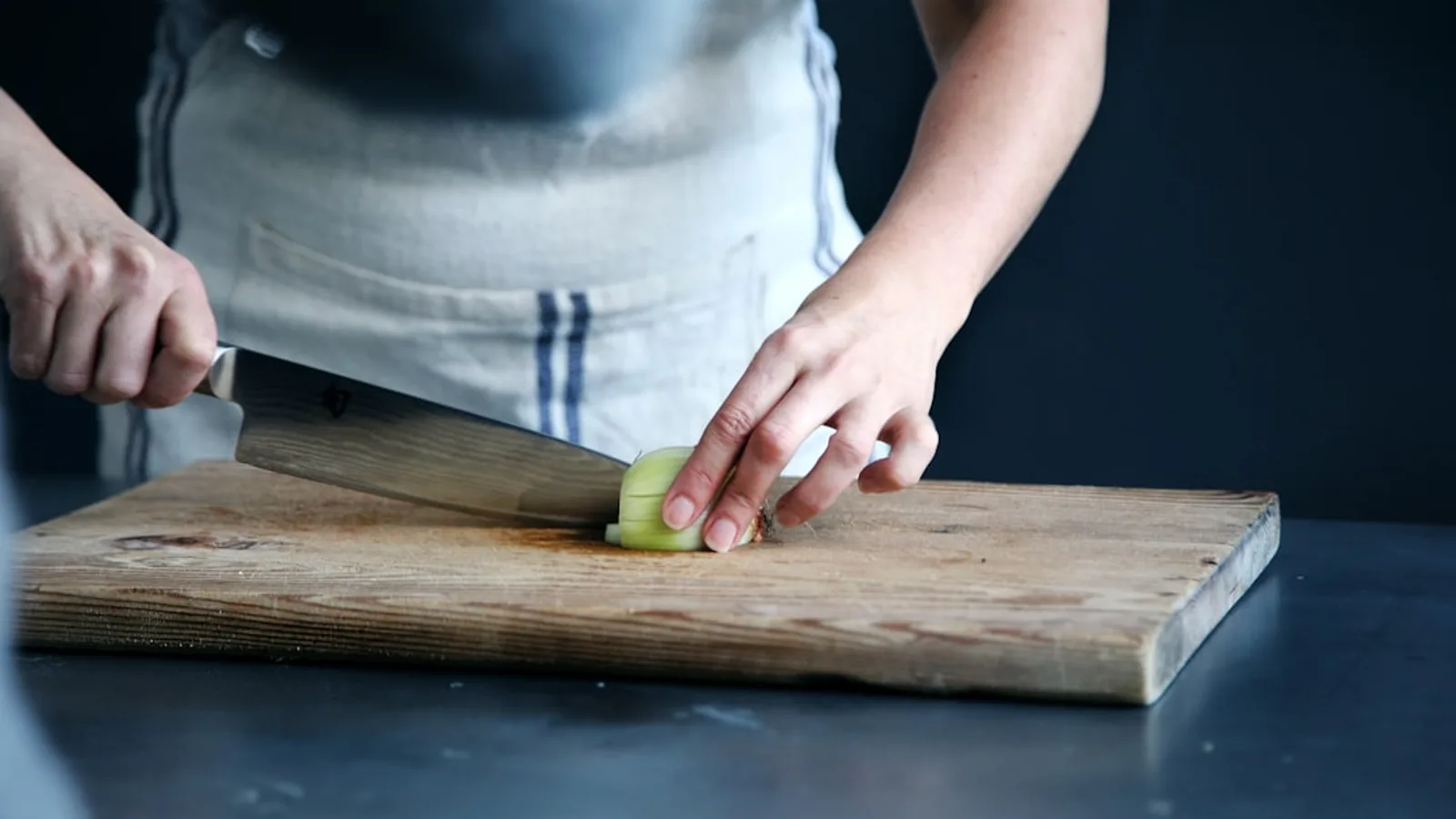
There’s a particular kind of stubbornness to onion tears. You can try cutting under running water, chilling the onion first, wearing goggles you swore you’d never actually need, and the sting still finds you. For a long time the explanation offered for this was fairly hand-wavy: onions release irritating sulfur compounds when cut, end of story. That explanation isn’t wrong exactly, but it skips the more interesting part. Onions don’t just leak an irritant as a byproduct of being sliced open. They manufacture it, on purpose, using a piece of molecular machinery that took scientists decades to actually find.
The old theory, and why it didn’t hold up
For most of the 20th century, the working explanation for onion tears went like this: onion cells contain a flavour precursor molecule, and when you cut into the bulb you rupture cell compartments that are normally kept separate. An enzyme called alliinase gets access to that precursor and breaks it down, and one of the breakdown products spontaneously rearranges itself into the eye-irritating compound. No second enzyme required. Just one enzyme doing its job, followed by an unstable intermediate falling apart into a stinging gas.
This idea had real chemistry behind it. The precursor is a cysteine sulfoxide called isoalliin, and alliinase does cleave it into a reactive sulfenic acid plus pyruvate and ammonia [1]. What was assumed for a long time is that this sulfenic acid then rearranges on its own, through what’s called a [1,4]-sigmatropic shift, into the lachrymatory factor. The catch is that this rearrangement, calculated in the gas phase, carries an energy barrier of roughly 33 kcal/mol, which is a lot to clear spontaneously at room temperature [3]. That’s the kind of detail that should make you suspicious of a “just happens on its own” explanation, and it turned out to be exactly the right thing to be suspicious about.
Finding the actual enzyme
In 2002, a research team at House Foods Corporation in Japan (a company that, fittingly, has some commercial interest in less tear-inducing onions) tracked down what was actually going on [1]. They took crude alliinase extracted from garlic and added it to the onion precursor isoalliin. If the old theory were correct, this substitution shouldn’t matter much, since alliinase was supposedly the only enzyme needed. Instead, no lachrymatory factor was produced at all. The garlic alliinase generated a different downstream product entirely.
That result pointed to a second, previously unidentified enzyme hiding inside onion tissue. The team isolated it by running crude onion alliinase preparation through a purification column, which separated the lachrymatory-factor-forming activity from the alliinase activity cleanly, into three distinct proteins that all shared the same amino-terminal sequence, meaning they were products of one gene [1]. They named this enzyme lachrymatory-factor synthase, or LFS.
This is a fairly clean piece of evidence. It’s not that alliinase makes a bit of tear factor and LFS makes more. It’s that alliinase, on its own, cannot make the compound at all. Without LFS, onion cells sacrifice tears for extra thiosulfinate, the class of compound responsible for a lot of fresh onion’s characteristic flavour [1]. The tear factor and the flavour compounds are, in a sense, competing for the same raw material, and LFS is what tips that competition.
What makes this enzyme unusual
Once LFS was on the map, the next question was how unique its trick actually is across the plant kingdom, and the honest answer turned out to be: not very. A few other plants make eye-irritating sulfines through what look like parallel systems, but they don’t all use the same mechanism to get there.
Research comparing onion, the Amazonian plant Petiveria alliacea, and Nectaroscordum species (a subgenus of ornamental onion relatives) found that all three produce a lachrymatory sulfine from a sulfenic acid intermediate, but by fundamentally different chemistry [2]. In onion, the sulfenic acid precursor already carries the right kind of unsaturation to become the lachrymator through a rearrangement, no electrons need to be added or removed, just shuffled around. In Petiveria, the equivalent precursor lacks that unsaturation, so its LFS-type enzyme has to pull off an actual oxidation, stripping two electrons and two protons from the substrate with help from a benzene ring that stabilizes the resulting charge [2]. That’s a meaningfully different job. Based on this, the researchers proposed that onion’s enzyme should really be classified as a “sulfenic acid isomerase,” since it rearranges rather than oxidizes, while the Petiveria enzyme is more accurately a “sulfenic acid dehydrogenase” [2].
What’s notable is that these two enzymes aren’t closely related despite doing conceptually similar jobs. Plants appear to have separately arrived at the idea of “make a dedicated enzyme whose job is specifically to produce an eye-irritating gas,” using different molecular toolkits each time. That’s a decent hint that this trait is worth the metabolic cost, evolutionarily speaking, which tracks given that we’re talking about deterring animals from eating you.
What the enzyme actually looks like
Knowing that LFS exists and roughly what it does is one thing. Seeing its physical structure is another, and that came later, in 2017, when researchers solved the crystal structure of onion LFS [3].
What they found was a compact protein built around a seven-stranded beta sheet that wraps around a long alpha helix, a shape known as a helix-grip fold [3]. This fold shows up in a specific family of plant proteins called START domains, most of which are known for binding lipids or hormones rather than catalyzing reactions. In fact, LFS turns out to be structurally similar to plant hormone receptors that bind abscisic acid, sharing the same general architecture despite having a completely different job [3]. It’s a good example of evolution repurposing an existing structural framework rather than inventing something from scratch.
Inside that fold sits a small internal pocket, notably smaller than the equivalent pocket in the hormone receptors it resembles, since it only needs to accommodate a much smaller substrate molecule [3]. Two amino acids inside this pocket, an arginine and a glutamate, appear to do the actual catalytic work. The proposed mechanism goes roughly like this: the glutamate acts as a base and pulls a proton off the sulfenic acid, which is only possible because a hydrogen bond from the nearby arginine keeps that glutamate primed to do so. This proton removal sets off a rearrangement that forms the sulfur-oxygen double bond characteristic of the lachrymatory factor, while leaving a brief carbanion at the other end of the molecule. A nearby tyrosine residue then supplies a new proton to that carbanion, finishing the product [3]. When researchers mutated either the arginine or the glutamate, the enzyme stopped working entirely, which is about as strong a confirmation of a mechanism as you can get from mutagenesis experiments [3].
There’s a neat supporting detail here too. Earlier work had shown that when the reaction runs in heavy water (D2O), the resulting lachrymatory factor picks up a single deuterium atom, always on the same side of the molecule relative to the oxygen [3]. That’s exactly what you’d expect if a specific tyrosine, sitting on one particular side of the enzyme’s active site, is the one supplying the replacement proton. A messier, non-enzymatic rearrangement wouldn’t produce that kind of consistent, one-sided labeling.
Why your eyes actually react
None of this explains, on its own, why a tiny volatile molecule drifting off a cutting board makes your eyes water rather than, say, your nose run or your skin itch, though it does plenty of that too if you rub your eyes afterward. The lachrymatory factor is small and volatile enough to travel through the air and reach the surface of your eyes, where it irritates sensory nerve endings from the trigeminal nerve. That irritation triggers a reflex tearing response, the same basic system responsible for watering eyes from smoke or strong wind, just with a very specific molecular trigger in this case.
From the plant’s perspective, this is defense chemistry doing exactly what it evolved to do, just aimed at your face instead of at whatever insect or grazing animal it was originally built for. The fact that it’s so effective on humans is closer to incidental than intentional, since we weren’t really the target audience.
Where the “no more tears” onion idea comes from
Once LFS was identified as a discrete gene with a specific job, an obvious idea followed: what happens if you switch it off? Researchers have already shown that silencing LFS expression in onions produces a “tearless” variety that doesn’t trigger eye irritation when cut, and doing so shifts the plant’s organosulfur chemistry toward more thiosulfinate production instead [1]. Since alliinase keeps working normally in these plants, most of the underlying flavour and nutritional chemistry stays intact, at least in principle. Whether a truly tearless commercial onion becomes common on grocery shelves is more a question of breeding programs and consumer taste testing than of remaining scientific mystery. The core biology of why onions make you cry, at this point, is fairly well pinned down.
The short version
Onion tears aren’t leftover chemistry from cutting into a vegetable. They’re the output of a dedicated enzyme, lachrymatory factor synthase, that evolved specifically to convert a reactive intermediate into a volatile eye irritant, competing directly with the pathway that would otherwise make more flavour compounds instead. Different plants that produce similar tear-inducing chemicals arrived at the ability through different molecular routes entirely, and the structure of onion’s version shows a repurposed hormone-receptor fold doing an unrelated catalytic job through a fairly elegant proton-shuffling mechanism. It’s a small enzyme with an outsized effect on anyone standing over a cutting board.
Common Questions
Is the lachrymatory factor the same compound that gives onions their flavour?
No. Flavour mostly comes from thiosulfinates and their breakdown products. The lachrymatory factor, propanethial S-oxide, is a separate compound made by a dedicated enzyme, and it's specifically what drifts up and irritates your eyes.
Can onions be bred to stop making you cry?
Yes, at least in principle. Silencing the gene for lachrymatory factor synthase has already been shown to produce onions that don't trigger eye irritation on cutting, while keeping most of the underlying flavour chemistry intact.
Does chilling an onion before cutting actually reduce tears?
It helps somewhat, since the reactions involved are enzymatic and slow down at lower temperatures. It won't eliminate the effect, though, since the enzyme and its substrate are still both present and still able to react.
Why does garlic not make your eyes water the same way?
Garlic uses a different precursor molecule that doesn't get converted into the same eye-irritating compound. Garlic has plenty of pungent, flavour-driving chemistry, but not the specific enzyme-substrate combination that produces onion's lachrymatory factor.
References
- [1]Imai S, et al. An onion enzyme that makes the eyes water. Nature. 2002
- [2]He Q, Kubec R, Jadhav AP, Musah RA. First insights into the mode of action of a lachrymatory factor synthase. Phytochemistry. 2011
- [3]Silvaroli JA, et al. Enzyme That Makes You Cry: Crystal Structure of Lachrymatory Factor Synthase from Allium cepa. ACS Chem Biol. 2017