Why Does Spicy Food Feel Hot? The Biology of Capsaicin
Spicy food feels hot because capsaicin activates TRPV1 heat receptors, not because your tongue is burning. The biology of the burn.
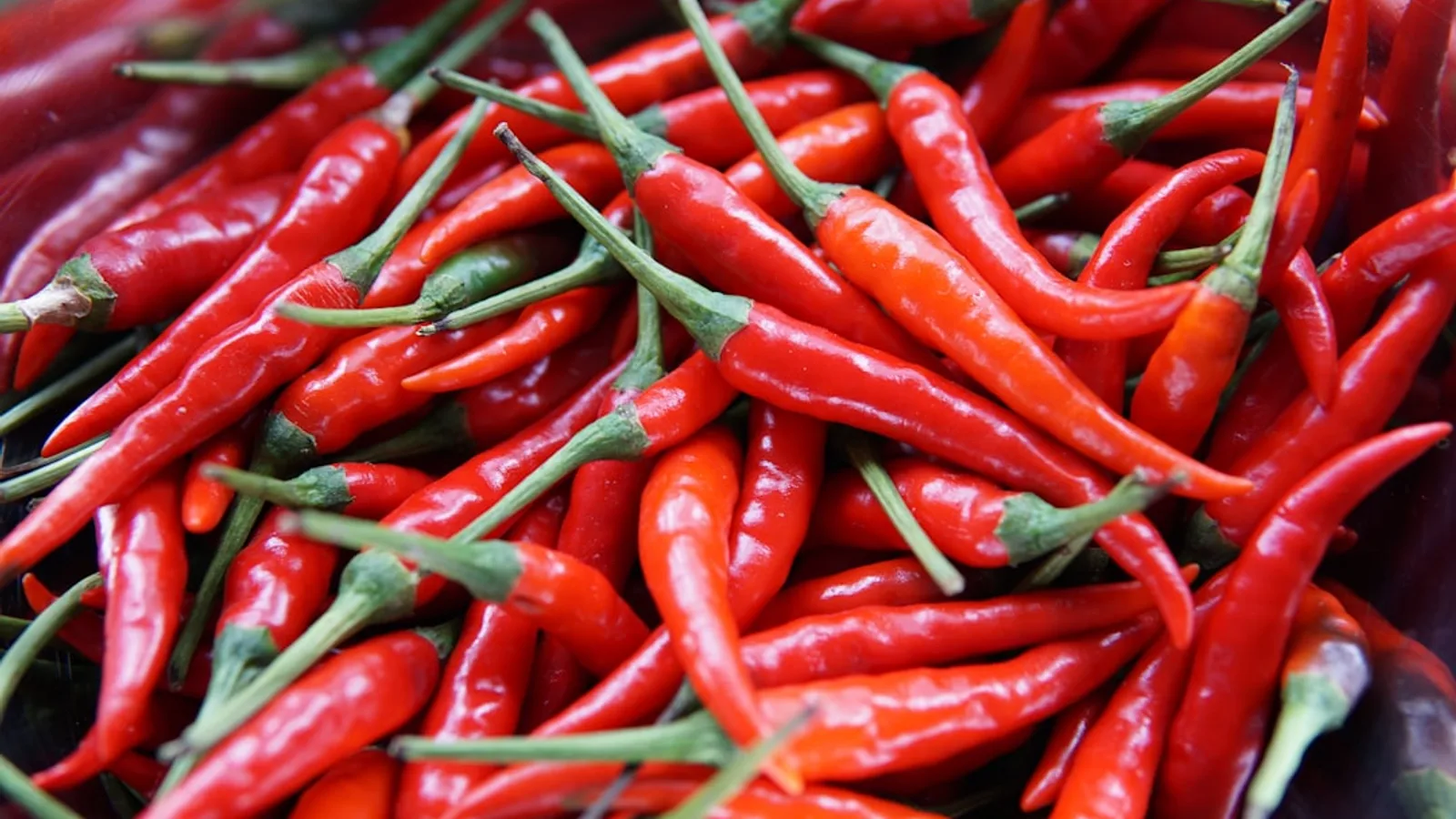
There’s a specific moment, maybe three seconds after biting into something spicier than you expected, when your brain starts sending increasingly urgent signals that something is wrong. Your eyes water, your nose starts running, and you’re suddenly very aware of your own tongue. And yet nothing is actually burning. There’s no tissue damage, no rising temperature, nothing you could point to under a microscope and call a burn. So why does it feel so convincingly like one?
The short answer is that your body has been tricked, and it’s a surprisingly elegant trick at that. The longer answer involves a single receptor, a molecule shaped almost perfectly to exploit it, and a part of your brain that can’t tell the difference between “hot” and “capsaicin.”
The receptor that started it all
The whole experience comes down to a protein called TRPV1, short for transient receptor potential vanilloid 1. TRPV1 sits on the surface of certain nerve endings, mostly in your mouth and throat, and its actual job is to detect heat. Specifically, it activates once tissue temperature climbs above roughly 43°C, which is right around the point where heat starts to become genuinely damaging to your cells. It’s a warning system, not a taste receptor, even though it lives right next to your actual taste buds.
Capsaicin, the compound responsible for chile pepper heat, happens to be shaped in a way that fits into TRPV1’s vanilloid binding site almost as well as heat itself does. When capsaicin locks into that site, it triggers the exact same chain of events that high temperature would: an influx of positively charged ions into the neuron, a burst of electrical activity, and a signal racing up to your brain that reads, unmistakably, as burning. Your brain has no separate channel for “chemical pretending to be heat.” As far as it’s concerned, the mouth is on fire, so it responds accordingly.
This is also why the sensation lingers so much longer than you’d expect from a food. Capsaicin isn’t washed away or metabolized the moment it touches your tongue. It sits in the tissue, continuing to activate TRPV1 receptors, which is part of why a genuinely hot pepper can leave your mouth burning for what feels like an unreasonable amount of time. Researchers at the Chile Pepper Institute have documented cases where the sensation lasted up to 12 hours after eating [1], long after any trace of the food itself is gone.
Not all heat is created equal
If you’ve ever eaten a habanero and a jalapeño back to back, you probably noticed that the heat itself felt qualitatively different, not just stronger or weaker. That’s not just in your head. A 2017 study out of New Mexico State University’s Chile Pepper Institute set out to build an actual descriptive vocabulary for chile pepper heat, the same way wine or coffee has a standardized language for describing flavor [1].
After years of tasting sessions with trained panelists, the researchers landed on five key attributes that define a chile pepper’s “heat profile”:
- Development: whether the burn hits immediately or builds up over 5, 15, or 30 seconds
- Duration: whether it fades in seconds or lingers for minutes or hours
- Location: where in the mouth you actually feel it, whether that’s the lips, the tip of the tongue, the mid-palate, or the back of the throat
- Feeling: described as either “sharp,” like pins pricking the tissue, or “flat,” like the heat is being smeared on with a brush
- Intensity: the overall strength, generally tied to Scoville Heat Units
Using this framework, some clear patterns show up across species. Habaneros and other Capsicum chinense varieties tend to be delayed, flat, and centered at the back of the throat, with heat that lingers for a long time [1]. Jalapeños, on the other hand, hit fast and flat right at the tip of the tongue, then fade fairly quickly [1]. Rocoto peppers, a Capsicum pubescens variety, are described as rapid and “incredibly sharp,” producing a whole-mouth effect that includes the lips, mid-palate, and throat, and are noted as having one of the longest lingering heats of any chile [1].
It’s a good reminder that heat level alone, measured in Scoville units or parts-per-million of capsaicinoids, doesn’t capture the actual experience of eating a pepper. There are 22 known naturally occurring capsaicinoids [1], and each one produces a slightly different sensation. Nordihydrocapsaicin, for example, has been described as producing a “mellow warming effect” that develops immediately and recedes quickly, while homodihydrocapsaicin is far more harsh and slow to fade [1]. Different peppers contain different ratios of these compounds, which is part of why heat profiles vary so much even between peppers of similar overall intensity.
What your brain does with the signal
Knowing that capsaicin fools a heat receptor explains the burning sensation itself, but it doesn’t explain why eating something spicy also makes you sweat, flush, and occasionally question your life choices. For that, you have to look at what’s happening deeper in the brain.
A 2016 fMRI study gave capsaicin to 20 subjects while scanning their brains, comparing the response to a salt solution and to a tasteless artificial saliva control [2]. As expected, capsaicin activated the middle and posterior short gyri of the insula, a region known as the primary gustatory area, essentially confirming that the brain does register capsaicin as a taste [2]. But it also lit up a separate region called the anterior short gyrus (ASG), which is associated with autonomic sensory-motor integration rather than taste itself, and it activated that region even more strongly than the gustatory area [2].
This matters because the ASG is tied to things your body does automatically: adjusting blood flow, regulating heart rate, controlling sweat. And sure enough, the study found a measurable physical effect to go along with the brain activity. Fingertip temperature rose significantly after capsaicin exposure, by close to a full degree Celsius on average, while the salt and control solutions produced no meaningful change [2]. The researchers found a significant positive correlation specifically between activation in the ASG and that fingertip temperature increase [2], suggesting this particular brain region is doing real work in driving the body’s physical response to spicy food, not just registering that something spicy happened.
Notably, the study also found no significant activation in the brain regions typically associated with genuine pain processing, at least at the capsaicin concentration used [2]. That lines up with something researchers have suspected for a while: a mild to moderate amount of capsaicin triggers the body’s autonomic and thermal systems without actually tripping the pain matrix the way, say, a burn or an injury would. Your body reacts as though something warm is happening and adjusts accordingly, rather than reacting as though you’re being harmed.
Why some people can handle way more than others
Anyone who has eaten spicy food with a group of friends knows that tolerance varies wildly. Part of this comes down to repeated exposure. TRPV1 receptors can become less responsive over time with regular capsaicin exposure, which is a big part of why frequent hot sauce users build up what looks like tolerance.
But there also seems to be a genuine baseline difference between people, tied to genetics. The same way individuals differ in their ability to taste bitter compounds due to specific genetic variation, people also appear to differ in their underlying sensitivity to chile pepper heat. Researchers who developed the chile pepper heat lexicon noted this directly, pointing out that while every taster has the potential to sense all five attributes of a chile pepper’s heat profile, less sensitive tasters may only pick up on one or two of them [1]. That’s part of why a properly trained sensory panel, made up of people with a range of sensitivities, ends up giving a more complete picture of a pepper’s actual profile than any single taster could.
Culture plays a role here too, and not just in a “some people just like spicy food more” sense. The chile pepper researchers point out that different culinary traditions actively prefer different heat profiles, not just different intensities. Asian cuisine, for instance, tends to favor a heat that builds rapidly, feels sharp, and dissipates quickly, while a dish built around New Mexican chiles favors a much flatter, more gradual heat [1]. Using the “wrong” style of pepper, even at a matching Scoville level, can genuinely change whether a dish reads as authentic within that tradition.
Summary
There’s something a little strange about capsaicin when you step back and look at it as a whole. It’s a molecule that produces no actual damage, yet convinces one of your body’s most reliable warning systems that damage is imminent. That false alarm cascades outward, triggering not just a localized burning sensation but a measurable, whole-body autonomic response, all without tripping the brain’s actual pain circuitry along the way.
So the next time your mouth is on fire from a spoonful of something you probably should have approached more cautiously, you can take some comfort in knowing exactly what’s happening. Your TRPV1 receptors are doing precisely what they evolved to do. They’re just responding to a very convincing impostor.
Common Questions
Does capsaicin actually burn your mouth?
No. There is no tissue damage happening. Capsaicin binds to the TRPV1 receptor, the same receptor that normally responds to temperatures above about 43°C, so your brain interprets the signal as heat even though nothing is actually hot.
Why does spicy food make me sweat and feel my heart race?
An fMRI study found that capsaicin activates the anterior short gyrus of the insula, a region tied to autonomic function, even more strongly than the primary taste region. That activation is linked to real physiological changes like increased fingertip temperature, part of the body's broader autonomic response.
Why do some chile peppers feel different from others even at the same heat level?
Researchers at the Chile Pepper Institute developed a five-part descriptive vocabulary (Development, Duration, Location, Feeling, and Intensity) to capture this. A habanero and a jalapeño can have similar Scoville ratings but completely different heat profiles because of where and how the burn develops.
Is capsaicin sensitivity genetic?
There is individual variation in how people perceive chile pepper heat, and researchers have linked differences in bitter taste perception to specific genes. While the full genetics of capsaicin sensitivity are still being worked out, everyone appears to carry the biological hardware to detect it, just to different degrees.
References
- [1]Guzman I, Bosland PW. Sensory properties of chile pepper heat and its importance to food quality and cultural preference. Appetite. 2017
- [2]Kawakami S, et al. The Brain Mechanisms Underlying the Perception of Pungent Taste of Capsaicin and the Subsequent Autonomic Responses. Front Hum Neurosci. 2016